Stimflash improves overall production performance
Oxidative stress: a reality in the field and a key to improving livestock performance
The process of oxidative stress is now well understood. Highly reactive molecules produced by the body, known as “free radicals”, damage vital tissues. Under normal circumstances, these molecules are neutralized by the body’s protective mechanisms known as antioxidants. These antioxidants prevent free radicals from reaching their targets and damaging them.
Free radicals are the result of stress experienced by the animal:
- Pathogenic infections
- Environmental changes (temperature, feeding transitions, handling, etc.)
- Elevated metabolism, particularly during periods of high production (peak laying, growth)
Oxidative stress affects performance
During periods of stress or pathogenic pressure, the production of free radicals is greater than that of antioxidants, leading to oxidative stress and/or inflammation. Many micronutrients are then redirected to boost natural defenses rather than being used for meat or egg production. This nutritional reallocation directly contributes to a decline in zootechnical performance.
It is estimated that 70% of the decline in performance is due to reduced feed intake and 30% to the immune response, which redirects part of the ingested nutrients to activate the immune response (particularly white blood cells and antibodies) — Journal of Pathology, vol. 181: 257–266, 1997.
Better management of these oxidative stress issues therefore represents a real lever for improving production performance in broiler, layer, and breeding poultry.
Metabolic reallocation: reduced production of muscle proteins under stress
Stimflash improves overall production performance, particularly under adverse conditions
Thanks to its unique formulation (developed through CCPA research), which is rich in vitamin C and antioxidants, Stimflash supports animal performance and contributes to avoid a drop in feed intake during periods of stress. It thus helps reduce metabolic diversion and redirects nutrient intake toward production (meat, eggs, etc.) to maintain and improve performance.
Proven Benefits
- Poultry breeding: continued egg-laying
Experimental Station Trial, 2009
3 applications of Stimflash at 55, 57, and 59 weeks of age (Lohman Brown)
- Broiler chickens:
Trials in Tunisia 2025–2026
These trials confirm the effectiveness of Stimflash in broiler production.
Two trials conducted on Tunisian farms (Arbor Acres and Cobb strains) evaluated the impact of Stimflash, administered at 1.5 ml/L of water from Day 5 to Day 8, on the zootechnical performance of broiler chickens. The results show a significant improvement in performance and a reduction in production costs.
- Decrease in the Consumer Price Index
- Reduced mortality
- Improvement in the performance index and average daily gain (ADG)
- Optimization of feed costs per 1 kg of live weight
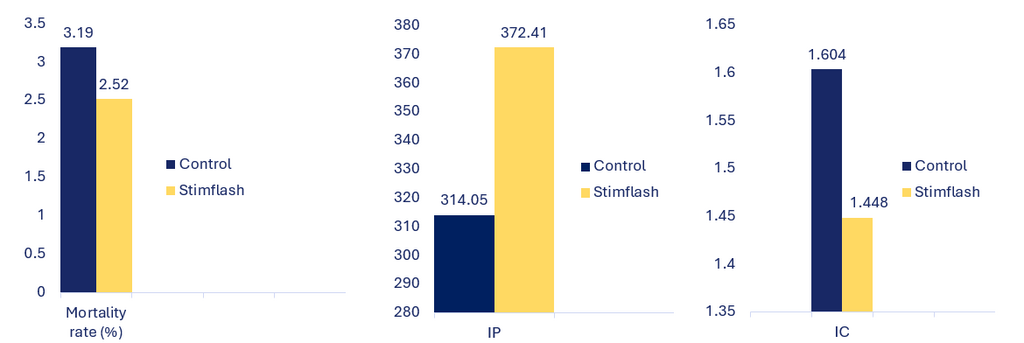
- 49,000 Arbor Acres broiler chickens
- 1 control batch
- 1 Stimflash batch
- 1.5 ml per liter of water from Day 5 to Day 8
- IC : Control 1.604 / Stimflash 1,448
- Mortality rate: Control group 3.19% / Stimflash 2.52%
- IP : Control 314 / Stimflash 372
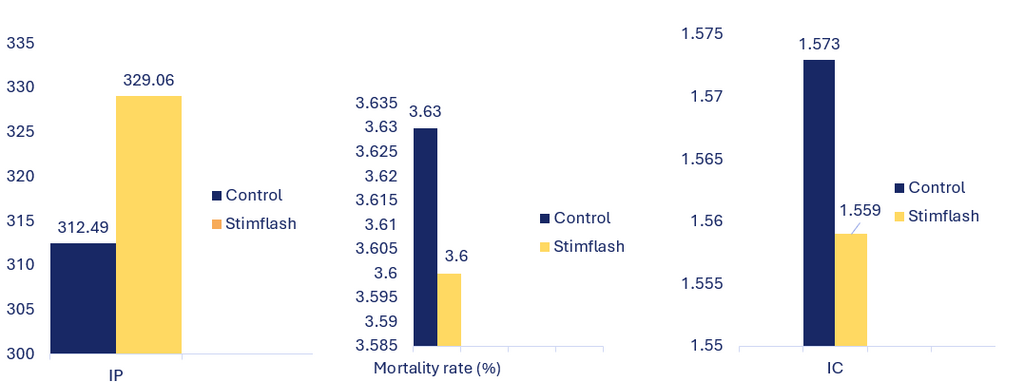
- 43,000 Cobb-line broiler chickens
- 1 Control batch
- 1 Stimflash batch
- 1,5m per liter of water from Day 5 to Day 9
- IC : Control 1,573 / Stimflash 1,559
- Mortality rate : Control 3,63 % / Stimflash 3,60 %
- IP : Control 312 / Stimflash 329
On two farms and with two different strains, Stimflash improves ADG, FCR, and FPI, while helping to reduce or stabilize mortality. It is a reliable performance enhancer for broiler production.
For use during sensitive times
- Broiler chickens: start-up, feed transitions.
- Female chicks: transfer.
- Laying hens: onset of egg-laying and peak egg-laying
- Breeding stock: after viral infection and to improve chick quality.